

Influences
Black Sabbath
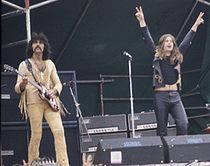 Photo credit: Padgett22 (Wikipedia) Licence: CC-BY-SA 3.0 |
Considered the first true heavy metal band (some believe this title belongs to either Led Zeppelin or Deep Purple), Black Sabbath are famous for a wealth of timeless riffs and frontman Ozzy's distinctive metal vocals. They explored ways to create a 'bigger', heavier sound, turning the amps right up and bending guitar and bass strings to produce a deeper, more powerful sound than their predecessors. Some of Sabbath's deep sound is owed to the down-tuning Iommi was forced to use following the loss of his fingertips in an industrial accident. Geezer's lyrics focused on the dark or depressing aspects of life, contrasting starkly with the contemporary hippy movement. Guitarist Iommi penned numerous classic riffs, including Iron Man, Paranoid, N.I.B. and War Pigs.
For me, Black Sabbath's sound was a revelation, the first real heavy music that I had heard, at a time when I had just picked up the guitar and was searching for riffs to play. I loved their heavy sound and style right from the first track (Black Sabbath) on their Greatest Hits, but it was Children of the Grave which I found truly unbelievable, and it instantly convinced me that this was the style for me. Ever since learning Sabbath riffs, I have been influenced by Iommi's style, using power chords and palm muting to create bass-rich, powerful riffs. I have also been inspired by the sheer volume of bass in their live shows, which has a strong presence in the mix, unlike many bands where the bass player fades into the background.
Judas Priest
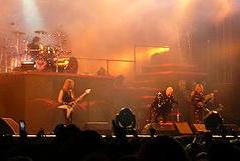 Photo credit: Äppelmos Licence: CC-BY 3.0 Unported |
The epitome of heavy metal, Judas Priest made the genre their own with innumerable scorching riffs, blistering guitar solos, the twin guitarist aural assault that is Glenn Tipton and K.K. Downing, the unbelievable falsetto vocals of Rob Halford and the definitive heavy sound, not to mention the leather-clad biker image and timeless metal lyrics. They moved from a blues-influenced style to heavy metal, and are famous for hits such as The Ripper, Exciter, Victim of Changes, Living after Midnight and Painkiller. Priest used synthesizers to great effect, adding a futuristic aspect to their sound on several songs; equally, they took the concept of metal to the extreme with intense speed and sonic power.
It's almost impossible for a metal band to not be influenced by the legacy of Judas Priest - they more or less are the genre. A fair bit of guitar influence comes from Priest, particularly some of the Painkiller album songs with their tradtional power chord riffs and arppegiated solo work. Priest inspired me to go heavier and demonstrated the importance of writing killer riffs and making the most of them.
Korn
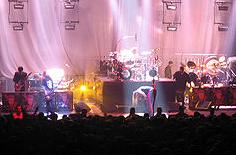 Photo credit: chadwho1ders (Chad Davis) (Flickr) Licence: CC-BY-SA 2.0 Generic |
The first band to be labelled nu metal, Korn used 7-string guitars, slap bass and John Davis' vitriolic and impassioned vocals to build a new brand of metal, as well as blending in grunge and funk style and even bagpipes on occasions. Korn produced a heavier sound than their predecessors with down-tuning and 7 string guitars. Korn's sound uses extreme bass coupled with some guitar high end sound, and virtually nothing in between. The bass guitar is high in the mix and neither of the two guitarists can generally be heard above the other. From heavy metal to rap and pop influences, their style has varied significantly between albums.
Listening to Korn's Take A Look In The Mirror fixed a broad grin on my face, after about five seconds, that I couldn't get rid of - it was just so much heavier than anything I'd heard before. The way John Davis was able to articulate such powerful emotions in this and other albums made me really passionate about this band, though I haven't yet found a way to inject this into my own singing.
Linkin Park
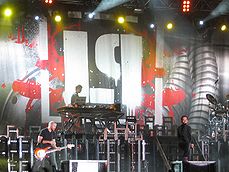 Photo credit: fortysix_vie (Flickr) Licence: CC-BY 2.0 Generic |
Arriving on the scene in 2000, with their blend of rap, hip hop and alternative rock, Linkin Park achieved great commercial success, becoming one the most successful nu-metal bands of the period. The added dimension of two contrasting vocalists permits different lyrical styles to run through their songs, to convey emotions in different ways, which can be very powerful. The band's use of harmonics, synthesizer and electronic sounds, including DJ scratching, builds a modern sound that complements their urban-inspired lyrics and rapping vocals.
Linkin Park were another big influence early on; in particular, I spent some time emulating their powerful, punchy bass drum sound from Meteora with my Boss DR-880 (although this is not present on Wasteland). Although I chose not to follow the trend of down tuning to drop-D, I took a lot of inspiration from their lyrical themes, which deal with relationship dynamics. I also spent some time trying to emulate their guitar tone, which led me to set a high gate on my guitar effects, so that chords could be played loud and resounding, but could be instantly cut when muting them for a staccato feel. Another thing I like about Linkin Park is that their sound has so much presence, which I have sought to follow carefully by recording with microphones as close as possible to the equipment. In the future, with better software, I would like to experiment with the extensive digital manipulation Linkin Park add as part of the creative process, such as flipping or repeating sounds, adding echo effects. This is achieved through use of Pro Tools software.
Machine Head
.jpg) Photo credit: Chad Davis Licence: CC-BY-SA 2.0 Generic |
American heavy metal at its finest, Machine Head have drifted from brutal hard rock through nu metal to a more traditional and thrash influenced style. Their epic, melodic masterpieces crafted from memorable riffs gained critcal acclaim with their latest album The Blackening, which has been named Metal Album of the Decade. Machine Head appear to have been influenced both by the groove metal of Pantera, most noticable on the album Burn My Eyes, and the epic thrash-based anthems and controlled riffing of Metallica. Their driving power riffs and intricate arpeggios are perfectly interwoven, along with Flynn's aggressively powerful lyrics. They continue to exceed expectations with their live performances, to the delight of metal fans worldwide.
Machine Head are simply awesome, with a similar sound to Pantera on their earlier albums, but always a more brutal riffing style than Dimebag's 'groove metal'. The success of The Blackening album is well deserved: this is another balanced, dynamic and beautifully crafted album. Similar to Tool, I was astounded by the clarity and precision of the riffing, which I hope to develop. To me, Machine Head are probably the band whose overall sound is closest to what I'm aiming for - heavy, complex and dynamically varied, with fantastic hi-gain guitar tone, but always melodic in their riffs.
Ozzy/Zakk Wylde
 Licence: CC0 |
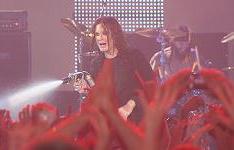
Original frontman of Black Sabbath, Ozzy Osbourne was allegedly fired from the band for excessive drink and drug abuse, but his career was reinvigorated when he formed a new band, bearing his name and featuring the amazing Randy Rhoads on guitar. Ozzy's brand of heavy metal was a hit, with a repertoire of classic songs including Crazy Train, Diary of a Madman, Bark at the Moon, Desire and Perry Mason. Ozzy's songs are full of power chord-driven riffs, epic gain and flamboyant guitar solos, not to mention the Ozzman's distinctive vocals. There are also several acoustic masterpiece moments and effect-laden guitar fills.
I first started listening to Ozzy shortly after I began recording with my Boss 8-Track Recorder, and quickly decided, after replicating Zakk Wylde's awesome JCM 800 guitar tone, that this was the style for me. In order to create the epic gain and distortion he achieves, I tend to record with my Flextone III at low volumes, which makes for a more balanced volume across high and low frequencies, without the need to compress the sound, which I find tends to limit the bass and resultant power of the sound. Zakk has a really classic metal sound, which is of course down to his British Marshall amps. I felt this fitted well with the riffs I had and offered a fuller, richer tone than the Mesa Boogie amp sound, which I had been using, which are used for the staple sound of nu-metal.
Another big appeal with Ozzy is the musical structure and craftmanship: songs like Perry Mason and Diary of a Madman utilise orchestral strings and acoustic guitars with epic riffs by both Zakk and the legendary Randy Rhoads (RIP). I have found it difficult to add such dynamic structure to my own songs, in part owing to my limited instruments, but I hope to add strings by use of Virtual Instrument software. The use of complex song construction, however, is beginning to find its way into some songs.
Pantera
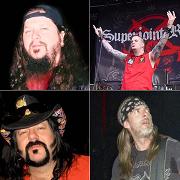 Photo credit: Anarkangel, April Ashford-Forsythe, Cannibaloki, Kurt Christensen, Mario, Mjfelker (Wikipedia) Licence: CC-BY-SA 3.0 Unported |
Pioneers of groove metal, Pantera were highly successful in the 1990s with a heavier sound with guitars tuned to drop-D, along with superhuman shredding, energetic drumming and shouting vocals full of the band's hard-rock attitude. Pantera successfully moved metal on from thrash, creating a heavier sound whilst consciously writing melodic riffs. In the 1980s, Pantera were originally a Glam rock band, but made little headway. Guitarist Dimebag's guitar-playing prowess was frequently showcased in his solos, but the real talent was in writing a series of classic, unforgettable riffs such as in Walk and Mouth for War.
Pantera made me realise that having a groove would be essential in my music. At times, I have dropped riffs or rewritten songs to ensure a groove was present. Sometimes adjusting the tempo or drum beat is all that's needed to add a groove into a good riff, but Dimebag's real talent was keeping it simple, particularly on songs such as Walk. In my opinion, the best and most memorable riffs are the simplest. They can be the heaviest and most powerful as well, which was another skill Pantera demonstrated time and again - how to write heavy, without compromising melody or rhythm.
Rage Against The Machine
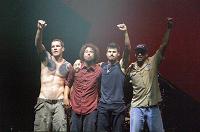 Photo credit: Penner (Flickr) Licence: CC-BY-SA 2.0 Generic |
Rage's hard edge rock with rapped lyrics and elements of funk in their songs delivers melodic pieces with a strong attitude. Their music has a significant funk element, but it is probably most memorable as a result of singer Zack De La Rocha's viciously outspoken and political lyrics, along with their caustic delivery. His fiercely emotive vocals transform the music and provide it with an edge that allows the rest of the band to concentrate on melody without comprimising the attitude conveyed in their collective sound.
RATM had a signficant influence on my riff construction, as I was listening to their self-titled album when I was first starting to write my own riffs and songs. The lyrics have a powerful and evocative message. However, it is definitely Morello's writing style that I have drawn inspiration from to begin creating my own riffs, a style that remains with me.
Rainbow
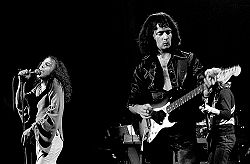 Photo credit: Helge Øverås Licence: CC-BY 3.0 Unported |
Ritchie Blackmore is one of Rock's all-time greatest guitarists; in Rainbow (his own creation), he was able to be more progressive and heavy than in Deep Purple. The band experimented with a variety of synth and keyboard sounds added into their mix, and the music reflected Blackmore's preference for writing hard rock. He introduced several lineup changes in order to maintain this style. Blackmore is famous for his guitar solos, which are the focus of his performances, notable for the feeling and variety.
Blackmore's riffs and solo licks were a particular influence, with my own writing style incorporating similar patterns. Rainbow's songs have also been an inspiration for song construction in some songs.
Rammstein
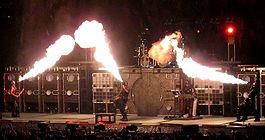 Photo credit: Metalium2 (Flickr) Licence: See here |

Rammstein's industrial metal is incredibly powerful, augmented by vocalist Lindemann's almost spoken lyrics and provided with added depth through use of synthesizers and electronic instruments. They are noted not only for their powerful industrial sound, but also their aggressive riffs, liberal use of pyrotechnics in live shows, controversial lyrics that deal with taboo subjects such as incest and sadomasochism and use of militaristic imagery. Lindemann's deep, resonating vocals are a crucial element of the music, completing their epic sound. Although their music is often described as violent and uses passages of noise and driving riffs, Rammstein also perform memorable moments of pensive music and varied dynamics.
Rammstein's music was what inspired me to add keyboard and other effects to my tracks. One of the main things I admire about Rammstein is their crafting of the album Rosenrot, which is a perfectly balanced album, with a blend of melody, dissonance, heavy and soft pieces. Another trick I picked up from them was where one guitar plays the same chord over and over, while the other guitar varies the chord position as usual, which doesn't clash as you might expect. Rammstein's industrial sound and song structure have been a strong influence, particularly their powerful wall-of-sound guitar sound.
R.E.M.
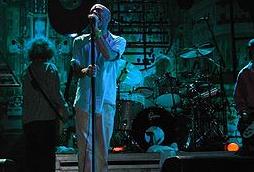 Photo credit: Stark! (Flickr) Licence: CC-BY-SA 2.0 Generic |
Rock band REM are noted for their arpeggiated guitar style, singer Stipe's iconic style and their contributions to the development of alternative rock; having risen from underground success to mainstream popularity and critical acclaim. They often perform acoustic tracks and Peter Buck uses a mandolin in some songs. String arrangements are sometimes present. Automatic For The People is considered by some to be their greatest album, which contains mostly slow, moving music and lyrics that deal with mortality and death, making for an incredibly emotional offering. It veers somewhat from their usual style, which normally contains more elements of rock.
Although not a metal band, REM's Automatic For The People really moves me in a way other albums don't. I didn't like it when I heard it as a child, asking why people would want to listen to something so slow and sad (although I never heard them at the time, my ideal band in my youth would probably have been Slayer, a phenomenon I could hardly believe on my first listening). Now, however, the emotional influence has helped me achieve a more dark and depressive atmosphere on some of my own songs, and showed me how to convey emotions in an effective way through my own musical style. I think you learn to appreciate slow/thoughtful music more as you get older, but that definitely doesn't mean the fast, heavy tracks are any less important!
Slipknot
 Photo credit: Chad Davis Licence: CC-BY-SA 2.0 Generic |
Following in the footsteps of Korn, Slipknot took the heavy side of nu metal to the next level, with extreme down-tuning, furiously aggresive lyrics, demonic guitar tone and blistering drumming combining to produce one of the heaviest bands in metal, earning them a devoted fanbase. In later albums, guitarist Mick Thompson has added thrash solos to the combination, which corresponds with their shift from nu metal to a more thrash oriented style.
My first experience of Slipknot was the album Volume 3: The Subliminal Verses, which truly did have a sublime quality with its atmospheric style and ferocity in Corey Taylor's vocals. Taylor's misanthropic lyrical style has been a big inspiration on my own; I was also suitably impressed by not only the amazing drumming of Jordison, but also the overall sound that the three percussionists create together. For a while, I didn't realize I could hear the percussionists in the mix, but it was revealed very quickly when I sat down and tried to replicate their drum sounds. Studying the guitar work also broadened my horizons: the riffs didn't fit the patterns and scales I was used to. I came to prefer their fuller sounding approach to nu metal than Korn, so have always worked with multiple guitar tracks high in the mix to create a meaty sound.
System Of A Down
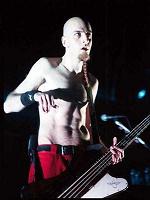 Photo credit: Downluke (Wikipedia) Licence: See here |

System of a Down have experimented with elements of folk music in their alternative metal style. They tune to drop-C to give their music a hard edge, and their style has similarities with thrash. The band are careful to write music that sounds original, and consequently do not place themselves in a particular style. System are noted for their outspoken views on the Armenian Genocide of 1915 (the band are of Armenian descent), as well as the US War on Terror. Their music has evolved over the course of their career, but has always retained a fast, heavy riffing element in most songs.
SOAD are one of the most unusual bands I've ever heard in metal; their Eastern European influence produced something totally original and works well with a heavy sound. System's thrash-influenced style is evidenced in their fast, energetic playing and makes for exciting music. System are a small influence on my lyrics, but I would like to incorporate some of Malakian's guitar playing style in the future. I admire the construction of some of their songs, particularly Chop Suey!, where fast, heavy power riffing is alternated with soft acoustic verses, until the song builds into an epic ending, complete with piano and strings for a full bodied sound.
Tool
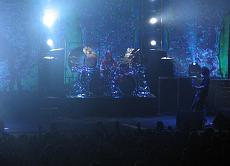 Photo credit: Rafal Klisowski Licence: CC-BY-SA 2.5 Generic |
Tool command a devoted following, probably as a result of heavy touring. Their albums are relatively lengthy and incorporate a complex musical style and structure, and their music is combined with visual arts to create a progressive, experimental image.They use odd time singatures and interlocking signatures and riffs, with a mathematical precision to both their writing and execution of the tracks. Various guitar and other effects are used, and at times the band achieves an Eastern style sound in their songs.
Tool's 10,000 Days album was a revelation to me, featuring perfection in guitar picking clarity and timing similar to that of Pink Floyd's guitarist, David Gilmour. Guitarist Adam Jones uses a style loosely based around power chords, which seemed very similar to my own style of playing, so that when I tried to tab Vicarious, I nailed most of the song first time around. In particular, after listening to Tool I was motivated to try more arpeggios in my own compositions.